Chiang Rai is the out-of-province trip most often chosen by people renting a car in Chiang Mai, and it is also a good route for a first long-distance EV drive, because the main road is a four-lane highway almost all the way, with petrol stations and cafes to stop at along the way. The distance is about 185 kilometres, around 3–3.5 hours without stopping. What you need to think about in advance is not the outbound leg, but the battery for sightseeing in Chiang Rai and the drive back.
The main route: Highway 118
Leave Chiang Mai on the Chiang Mai–Chiang Rai road (Highway 118) through Doi Saket district. The first 20 km or so are still suburban, with traffic lights and U-turn points. The next 40 km or so are more open, with gentle ups and downs, and then you enter about 40 km of mountains: long steep grades and wide curves, with truck lanes for overtaking, before descending into the valley at Wiang Pa Pao and Mae Suai. Highway 118 ends at Phahonyothin Road in Mae Lao district, and from there it is a short drive north to Chiang Rai city. The last stretch is flat and straight and easy to drive.
The mountain section is where the battery drops faster than usual. Do not be alarmed if the range figure on the dashboard falls faster than the distance you actually drive. On the way down, the EV uses regenerative braking to put some energy back into the battery, and if you set the deceleration level high you hardly need to touch the brake on long slopes.
Is the battery enough? A simple way to think about it
Use the same formula EVCNX recommends: subtract about 20% from the spec range. For example, the JAECOO 5 has a spec range of 461 km, so real-world range is about 369 km. The car leaves EVCNX with at least 85% battery and must be returned with no less than 20%, which gives you roughly 240 km of comfortable usable range. One way is 185 km, so you can arrive without stopping, but with not much reserve. The round trip is well over 370 km, so you will definitely need to charge at least once.
The most convenient approach is to charge in Chiang Rai city while sightseeing or before you head back. DC charging from about 30% to 80% takes around half an hour on a high-power unit (a 50 kW unit takes longer), which fits a meal or coffee break. If you plan to go straight on to Wat Rong Khun, Wat Rong Suea Ten and Baan Dam on the first day, top up at Wiang Pa Pao or Mae Lao first so you are not worrying about the numbers.
DC charging stops along the route
According to the station list published by the Provincial Electricity Authority (May 2024 edition), there are several PEA VOLTA fast-charging stations in petrol stations along this route: Doi Saket near the start, the Caltex in Wiang Pa Pao (up to 120 kW), the Bangchak in Mae Lao, and a Caltex in Chiang Rai city. Also check the apps of other networks, such as PTT's EV Station PluZ or EleXA, because charger information always changes.
- Open the PEA VOLTA, EV Station PluZ or EleXA app and check connector status before you leave. Some stations have only one unit, so if someone is using it you will have to queue.
- Always have one backup stop in mind. Do not let the battery get so low that you have only one option.
- Charging to about 80% is enough. From 80–100% the car charges much more slowly.
- Charging generally costs about THB 200–300 per session. Keep the receipt; EVCNX refunds 1 receipt.
Driving comfortably
In the mountain section between Doi Saket and Wiang Pa Pao there are slow trucks. Use the overtaking lane only when there is one. In the rainy season or on early cool-season mornings some sections have fog and slippery roads, so slow down. Mae Kachan hot springs, in the mountain section before Wiang Pa Pao, is a popular stop to stretch your legs, and has parking.
Pre-departure checklist
- Tell EVCNX you are going to Chiang Rai when you book, so the insurance covers you fully. The out-of-province surcharge is THB 600 (one-off).
- EVCNX has no branch in Chiang Rai. You must drive back and return the car at the Chiang Mai branch.
- Return the car with no less than 20% battery; there is no need to charge it full.
- If the battery is nearly empty or the car has a problem on the road, call 095-995-3000 (07:00–23:00).
Charging stops along the way
- PEA VOLTA บางจาก ดอยสะเก็ด — Choeng Doi subdistrict, Doi Saket district, Chiang Mai
DC 50 kW, 2 units (CCS2 / CHAdeMO) / inside a Bangchak station, near the start of the route before the mountains (data from the PEA VOLTA list, May 2024; check status in the PEA VOLTA app before you go) - PEA VOLTA คาลเท็กซ์ เวียงป่าเป้า — Pa Ngio subdistrict, Wiang Pa Pao district, Chiang Rai
DC 120 kW, 1 unit (2 CCS2 connectors) / inside a Caltex station, about two thirds of the way (data from the PEA VOLTA list, May 2024; check status in the PEA VOLTA app before you go) - PEA VOLTA บางจาก แม่ลาว — Chom Mok Kaeo subdistrict, Mae Lao district, Chiang Rai
DC 50 kW, 2 units (CCS2 / CHAdeMO) / inside a Bangchak station, close to Chiang Rai city (data from the PEA VOLTA list, May 2024; check status in the PEA VOLTA app before you go) - PEA VOLTA คาลเท็กซ์ เมืองเชียงราย (รอบเวียง) — Rop Wiang subdistrict, Mueang Chiang Rai district, Chiang Rai
DC 120 kW, 1 unit (2 CCS2 connectors) / inside a Caltex station in the city, a good place to charge before driving back (data from the PEA VOLTA list, May 2024; check status in the PEA VOLTA app before you go)
Charger status and power change — check EV Station PluZ, EleXA or the operator's app before you leave. EVCNX cars are delivered with 85%+ battery; return with at least 20%, and we refund one charging receipt.
Worth stopping for
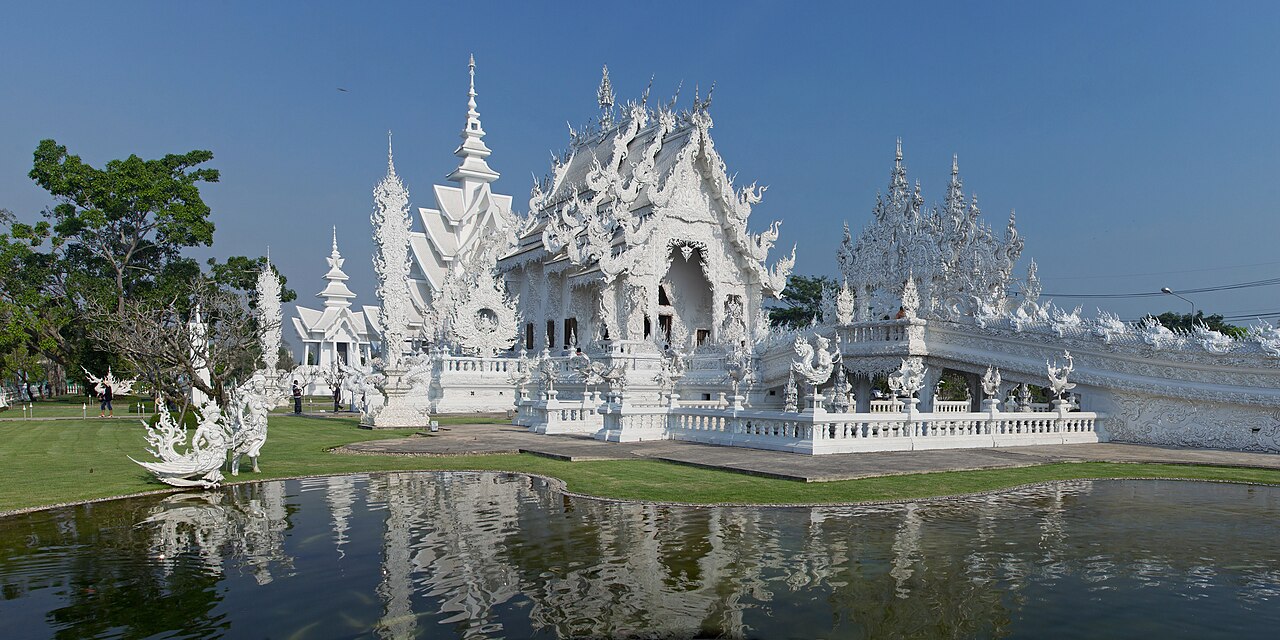
- Wat Rong Khun (the White Temple), south of the city
- Wat Rong Suea Ten (the Blue Temple)
- Baan Dam Museum, by artist Thawan Duchanee
- Chiang Rai Clock Tower, in the city centre
- Wat Phra Kaew, Chiang Rai
- Mae Kachan hot springs, a rest stop along Highway 118