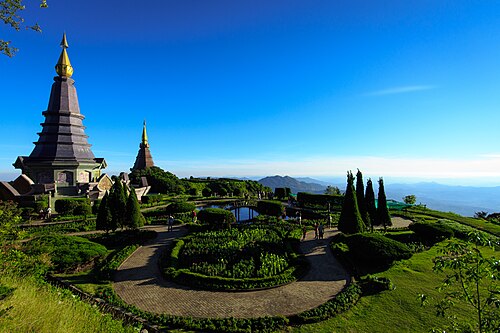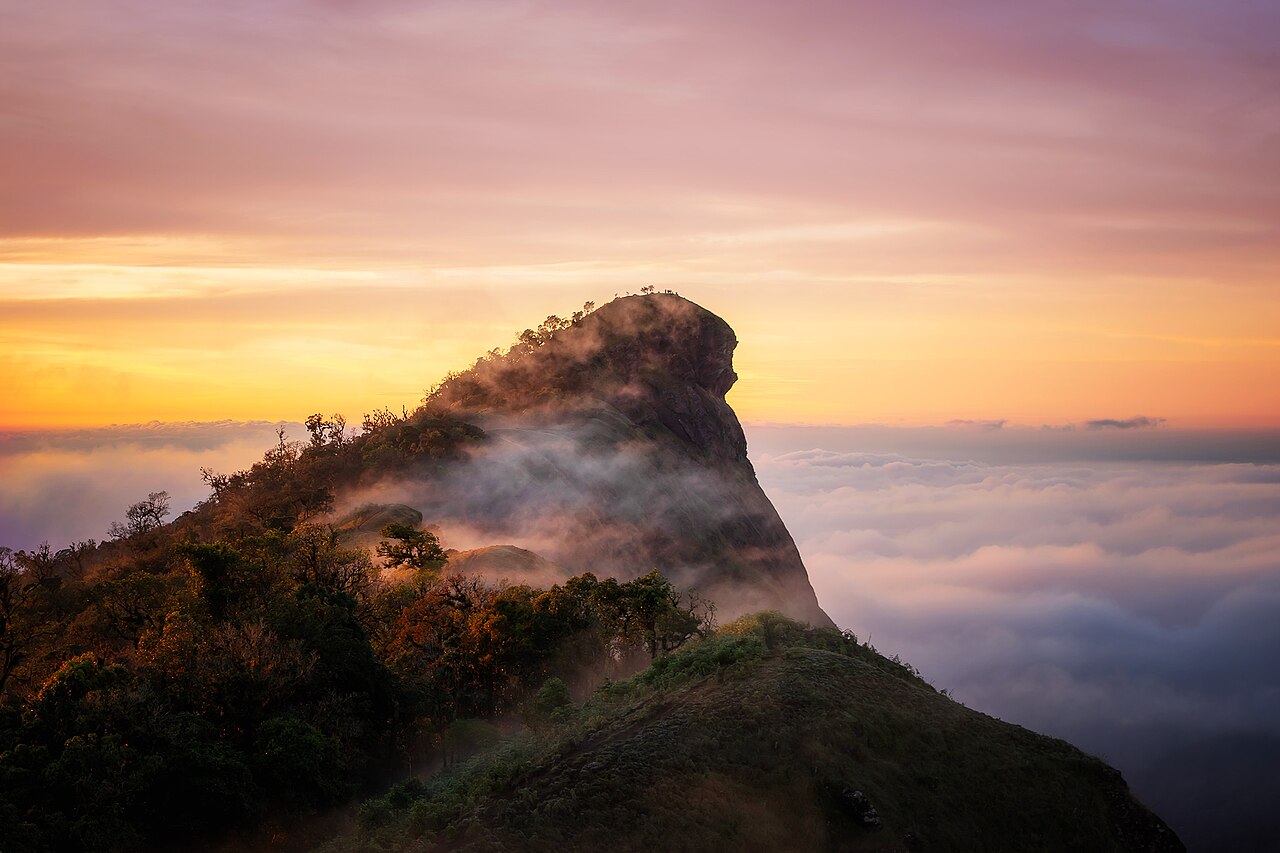
Doi Mon Jong, in the Omkoi Wildlife Sanctuary, is a grassy ridge about 1,929 metres high and an overnight trek that people from Chiang Mai wait for every cool season. The good news is that it is still inside Chiang Mai province, so there is no out-of-area surcharge. But to be honest, this is one of the hardest trips for a rented EV: it is long, the climb is long, there is no fast charger on the PEA VOLTA list after Hot district, and ordinary cars cannot reach the trailhead on the final stretch.
How far can an EV go?
The main route is Highway 108 through Hang Dong, Doi Lo, Chom Thong and Hot, up towards Bo Luang and Suan Son Bo Kaew, about 125 km in all. Then turn left onto Highway 1099 for about 40 km to Omkoi district town. From there, follow 1099 for another 40 km or so until you see the turning to the Mu Ser ranger post on your left. The total is about 205 km from the city (sources differ somewhat; one gives about 179 km from Chiang Mai to Omkoi district town).
The Mu Ser ranger post is the registration point and the end of the road for ordinary cars. From the post to the trailhead is about another 16 km of narrow gravel road that winds along cliff edges. It needs a four-wheel-drive vehicle and a driver who knows the road, and takes about 1–2 hours. Do not take a rented EV on this stretch. Park where the rangers advise and continue in a 4x4 from the villagers or arranged by the service centre. The price is negotiated: some past visitors' reviews quote from about THB 1,000 per trip, while another source says THB 3,000 return from the district town to the Ban Huai Pu Ling starting point. Ask for the latest price first. The car park is unattended, so do not leave valuables in the car.
Is the battery enough? Use EVCNX's formula
Use the same formula EVCNX recommends: subtract 20% from the spec range. For example, the BYD ATTO 3 has a spec range of 480 km, so real-world range is about 384 km. The car leaves EVCNX with at least 85% battery and must be returned with no less than 20%, which gives you roughly 250 km of comfortable usable range. But this trip is about 205 km one way and more than 400 km round trip, with a long climb in the second half, so no car in the EVCNX fleet with a published spec range can do the round trip on one battery. You need to charge at least once on the way out and once on the way back.
- Outbound: charge close to full at the Bangchak station in Hang Dong (120 kW) or Doi Lo (50 kW), then top up to full at PEA VOLTA Hot, the last fast charger on the PEA VOLTA list before the climb. Charging to full is fine here, because almost everything after this is uphill.
- The stretch with no chargers: the Hot roundabout is at about km 88 of Highway 108 and the junction onto 1099 is at about km 127, so from Hot to the Mu Ser post is about 120 km, roughly 240 km round trip with nowhere to charge, and the car has to stay overnight at the post.
- Is it enough? If you leave Hot with nearly 100% and arrive back at Hot with 20%, you have about 80% of real-world range: about 307 km for the ATTO 3, 320 km for the Good Cat 500, 314 km for the Dolphin Extended and 295 km for the JAECOO 5. All of these cover the 240 km stretch, but with little to spare because of the long climbs. Do not leave Hot without a full battery, and we do not recommend any model with a spec range lower than these.
- On the return: stop to charge at Hot or Doi Lo before entering the city. Do not let the battery drop below 20%.
- The unit at Hot is DC at about 25 kW with a single connector, so it is slow. If someone is using it you may have to wait, so do most of your charging at Hang Dong or Doi Lo and use Hot only to top up.
- Check the status of every station in the PEA VOLTA, EV Station PluZ and EleXA apps before you set off, in case there are new stations in Hot or Omkoi that are not yet on the list.
Driving up and down mountains in an EV
Long climbs use noticeably more energy than flat roads, and the remaining-range figure on the screen can drop faster than you expect. Go by the battery percentage. Drive steadily, avoid frequent overtaking, and use the air-conditioning moderately; it is already cool in the mountains. On the return, which is mostly downhill, set regenerative braking (regen) to the highest level or use one-pedal mode if the car has it, and let the car slow itself. Use the foot brake only before curves, so you get some energy back and the brakes do not overheat. The mountain roads are narrow with many curves, and there is morning fog in the cool season, so drive in the daytime and avoid driving at night.
Season, booking and the sanctuary's rules
Mon Jong is open only in the cool season, roughly November to mid-February. At other times it is closed for safety because of wildlife and the risk of forest fires. You must register in advance on the Omkoi Wildlife Sanctuary website (wildlifesanctuaryfca16.com/omkoi) and nowhere else. The rules change every year. The most recent season (2025–26) ran from 14 November 2025 to 15 February 2026, required booking at least 7 days ahead, was limited to 230 people a day, was closed on Wednesdays, required a ranger guide, and advised arriving at the service centre before noon. The season before required booking only 3 days ahead. As of writing, no announcement for the 2026–27 season had been published. Check the latest announcement before booking the car.
There are no shops or equipment rental on the mountain. Bring your own tent, sleeping bag, food and water. You can hire porters. The walk from the trailhead to the camping area is about 4–5 km and takes about 3–5 hours; most people go for 2 days and 1 night.
Pre-departure checklist
- Doi Mon Jong is in Chiang Mai province, so there is no out-of-area surcharge, but tell EVCNX when you book that you are going to Omkoi and leaving the car overnight at the Mu Ser post.
- Secure your trekking permit first, then book the car for the matching dates.
- Park at the Mu Ser post and continue in a 4x4. Do not drive the rental car onto the gravel road.
- Return the car with no less than 20% battery. Charging costs about THB 200–300 per session, and EVCNX refunds 1 receipt.
- If the battery is nearly empty or the car has a problem on the road, call 095-995-3000 (07:00–23:00).
Charging stops along the way
- PEA VOLTA บางจาก หางดง — Nong Khwai subdistrict, Hang Dong district, Chiang Mai
DC 120 kW (2 CCS2 connectors), open 24 hours / inside a Bangchak station near the start of Highway 108, a good place to charge close to full before a long drive (data from the PEA VOLTA website, checked Sep 2026; check status in the app before you go) - PEA VOLTA บางจาก ดอยหล่อ — Doi Lo subdistrict, Doi Lo district, Chiang Mai
DC 50 kW, 2 units (CCS2 / CHAdeMO), open 04:30–23:00 / inside a Bangchak station on Highway 108, usable on both the outbound and return legs (data from the PEA VOLTA website, checked Sep 2026; check status in the app before you go) - PEA VOLTA ฮอด — Provincial Electricity Authority office, Hang Dong subdistrict, Hot district, Chiang Mai
DC about 25 kW, 1 CCS2 connector only, open 24 hours / slow and a single unit, so allow time to queue; it is the last fast charger on the PEA VOLTA list before the climb to Omkoi (data from the PEA VOLTA website, checked Sep 2026; check status in the app before you go)
Charger status and power change — check EV Station PluZ, EleXA or the operator's app before you leave. EVCNX cars are delivered with 85%+ battery; return with at least 20%, and we refund one charging receipt.
Worth stopping for
- Pha Hua Sing, a lion-head cliff and a viewpoint for sunrise and the sea of mist
- The summit of Doi Mon Jong, about 1,929 metres high
- Grassland along the ridge that turns golden in the cool season
- Suan Son Bo Kaew (pine garden) on Highway 108
- Omkoi district town, a stop for food and supplies before entering the sanctuary